Friday, December 9, 2011

My Bucket List


Lately, since i turned sixty, I've been thinking more about the things that I would like to do. I don't just mean to climb a mountain or to see pyramid. But I am tired of having a list of things that I really hoped to get at, and then to come to the end of the day – the week – the year, and see that they are not done.
Lots of these items aren't just personal goals – they came to me when I was praying, and I honestly believed that my God was calling me to do something. Here is the start of my list of things that really matter to me:


  1. There are some key passages from the Bible that I want to study inside and out, in original languages and culture as well as current interpretations. So far, this list includes: Deuteronomy 6:1-25; Isaiah 53; Isaiah 55; John chapters 5-10; John 17; Ephesians 3:14-21; Colossians 1-4. (Perhaps I may memorize good portions of these.)
  2. Ask myself each week – is everyone in my family certain that I love them. Is there a way to show them and tell them again soon?
  3. Keep going on dates with Pat, letting her know that I'd rather be with her than anywhere else in the world.
  4. Pray and then ask myself each week: Who are the people that I can bless this week? Then do it.
  5. Review my 35 years of journals, take note of the significant moments of insight and record them together in one document.
  6. Take time to mediate on those insights, and to speak lovingly and honestly with my God every day.
  7. Begin a practice to record the dates of funerals that I lead, and continue to follow up with the family regularly as appropriate. Back date this practice for the last few years, and do the same for weddings and baptisms and child dedications.
  8. Be alert to current discussion and articles about Faith and Science, and other key questions of truth and worldview.
  9. Make sure that I have invited my family, my friends, people that I love, to choose Christ – not only to be ready for heaven, but to have the full robust faith needed for this life.
  10. I want to make music on my violin and piano and guitar, and ride my bike year-round.
  11. I want to read a book every two weeks and classic novel each year.
  12. I want to live out loud, and live generously as a spiritual life coach, equipping leaders and emerging leaders, and listening to anyone who needs to talk.
More things will hit the list, and some of these are getting checked off. When it is all said and done, I want no regrets. I will stand before God, full of worship and gratitude, and out of breath because life has been so full.

Wednesday, December 7, 2011

Whatever you believe must deal with these questions

Last week, I couldn't sleep, and began to wonder about a statement that I heard, "For something to be true, it must be true in all avenues of life." I must not have gotten it quite right, because I can't google it anywhere. If you find the original, let me know.  In any case the following comments came out of that sleepless hour....

As one considers the foundation for their world view, there are universal questions that need to be dealt with in any view of life. The greatness of these questions means that any view will have difficulty in fully satisfying them. Yet any view that fails to adequately deal with them cannot be considered valid. These questions include:

Material questions:
    1. The question of origins. Did the physical universe always exist, or did it come to be? It appears from the Law of Entropy that the universe must have had a beginning point. One could postulate that the Law of Entropy had a start point. If the universe came to be, how could it have begun? If the universe had a beginning, what was there before the beginning?
    2. The question of complexity. What explanations are possible for the complexity of the genetic code, the balance of nature and vastness of space.
    3. The question of eternity. What does “forever” mean?
Ethical Questions:
    1. The question of evil.
    2. The question of evil in me. If there is a true measure of what ought to be, and if I fall short, what prevents me from attaining that true measure?
    3. The question of morality and ethics. Is there a standard of right and wrong?
Spiritual Questions:
    1. The question of personality. Does the presence of personality in human beings and in other creatures point to a higher personality?
    2. The question meaning in the face of decay and death, The certainty of my own death and the death of all whom I might influence and the reality of the eventual decay of everything causes me to question the purpose and meaning of life and of the world. Is meaning to be found in this world, or is meaning to be found beyond this world?
    3. The question of love and beauty. Is an understanding of love and beauty essential to an understanding of the world, or is it possible to have a world view that does not assign value to love and beauty?
Rational Questions:
    1. The question of consistency. How can I explain the apparent presence of universal constants, physical, mathematical, logical, spiritual? These form the basis of discovery, the basis of reason and argument, and the basis a view of life. These constants are necessary for any discussion to take place.
    2. The question of truth. Is there truth, and is there a way to discover truth? Is there a means to weigh truth and opinions about truth? Is all truth found by searching? What other means of attaining truth may be considered? Is truth knowable?
    3. The question of responsibility. Is there a responsibility of each person to determine and to sift out what is true and to live in accordance with truth? Is it enough to attempt to seek truth? What is the consequence of living in a way that does not cohere with truth?

A system of belief must be able to answer these questions. The law of consequence would suggest that living by an incomplete system will bring one into conflict with the laws of the universe. It would appear that there must be only one system, and that such a system will have consistency, coherence, and universal application. One must not assume that one belief system will be as good as another, and one must reject a system of belief on grounds of personal preference or history.  

Wednesday, August 4, 2010

Body Image is a Spiritual thing

Recently (last Sunday, actually) I heard our Pastor Wayne, a really tall man, tell the congregation that, as a boy, he was a target for bullying because of his size. Kids would tease him about anything, but especially his non-namebrand clothing, just to see if they could disturb him. If he did get upset, they would know that they had found a way to show their power over him.
Our bodies are our primary vehicle to express our spirit, in joy or in woundedness, in fullness or in or in fear. Childhood and youth, especially from the ages of 9 years on up, are the most vulnerable. The focus on social standing becomes the testing furnace of a child's confidence and belief in who they really are. The negative beliefs about ourselves and the relational wounds that we carry can all find links to these critical years.
The wise teacher will help children talk about diversity in race, in abilities, and in body shape. They will help children to express how it feels when teased about appearance, and they will help other children to empathize by asking questions like, "When you see someone who is teased or bullied, what have you thought it would be like if it happened to you?" or "What would these words mean to you in that situation?"
At the core of our spirituality lies a decision to either trust God's wisdom and unfailing love or to take matters into our own hands. Unless we have the grace to trust God, the issues in our lives can control us and lead us to lash out, to "medicate" to cover up, or to live in shame. The path of acceptance and courage, of faith and generosity in Spirit is a difficult path, and there many opportunities to choose to leave the way.
The painful truth is that most of these choices will be wrong choices until the deep inner belief changes. As long as a child or adult believes that there is something unacceptable about their bodies or their circumstances, they are likely to make the wrong choice. Perhaps this is why ancient scriptures say that this is not by our own strength. "But the eyes of the LORD are on those who fear him, on those whose hope is in his unfailing love." Psalm 33:18 New International Version.

Friday, July 16, 2010

How do faith and generosity fit together?

Generosity goes hand in hand with a faith that is posited on a generous God. If we don't need to worry about clothes or food because our heavenly Father cares for us (in the words of Jesus), then we don't need to hoard them for ourselves. Similarly, if the creator God defines our value by the worth of our spiritual life, then we don't need possessions to define our value. If this world and all that we hold dear in this world will one day fade away, then we don't need to cling to them. We can use them to bring spiritual benefit to others. Those possessions can bring joy, encouragement, can provide food, and can inspire hope and life in people near and far. Faith gives a freeing perspective to life that enhances generosity. Generosity is part of the spiritual life because it lessens the hold of the material on our spirits.

Monday, May 24, 2010

The Evening Church Visits

We shared evening church visits at the Filadelfia church in Xochimilco on May 14, at the Neuvo Amanecer Church in Texcoco on May 19, and the Jerusalem church on May 21.

In each of these visits, accompanied by Daniel Ambriz and Daniel Valencia, Walter had opportunity to bring greetings to the people, and both he and I had short teaching sessions. Walter opened with acknowledgement of the pain that exists in the home, and gave practical ways to help resolve conflict. His teaching on The Blessing, taken from Gary Smalley's book of the same name, meant a great deal to people. He pointed out the frequency and the impact of blessings that were given in the Old Testament and in the New, and he higlighted five key and oft-repeated elements of the blessing.
These five elements are: physical touch, affirming words, communicating worth, listening to your child's dreams and putting them into a word picture and, reinforcing their dreams and hopes in practical ways. Since I didn't have Spanish language powerpoints ready for these evening gatherings, I prepared images of children at different ages and described the opportunities and the importance of teaching and encouraging children at each age.


The Filadelfia church, mentioned in an earlier blog, is led by Pastor Francisco Ranget. This church has doubled in attendance in a year, and continues to grow.


The Neuvo Amanecer (New Dawn) Church was full of people in the middle of the week.

This is Cedric, age 7, one of the most enthusiastic guitar players.Children are part of the life of the church, and little treats and nametags were waiting for them in the building.
The pastoral couple Josuet Alvarez and Carmen Garcia lead this church and two other churchers as well.  As one church grew strong, a daughter church was planted, and then the daughter church also planted a church.


Getsemani Church was the original mother church, and Neuvo Amanecer is the daughter church.
The third generation church plant, Neuvo Amanecer in Xalostoc, is the 'granddaughter' of Getsemani Church. The church in Xalostoc was the location of the quince party mentioned in an earlier posting. A Centre Street Church work team added a second story to this church, doubling the available space and allowing room for children's minstry.


On Friday evening, May 21, we attended the Jerusalem church. It is currently padlocked, due to a dispute with a neighbour. The sign tells of the various home meetings.  Please pray for a peaceful, gracous and just resolution to this problem.


Work teams from Centre Street Church put the second floor on this church during a recent visit.


The church, led by Pastor Reuben Velasquez, continues to function without use of a building. We met in a home and about 25 people were able to crowd in.
As sang and prayed and learned from each other, this home setting helped to anchor the important truths in the reality of everyday life.


Saturday, May 22, 2010

The VELA Training Centre

Today was the climax of our time in Mexico. The first weekend teaching sessions were focused on reaching and teaching children in the church and in the home. This second weekend concentrated on the home, particularly pastor's homes.
Walter Erion did the majority of the teaching this day and, even in the morning as we prepared to go, Walter and I both sensed that this would be a day that would be specially touched by the presence of God. It was clear throughout the week, and particularly on this day that people knew and loved Walter deeply. They knew him well and appreicated his connection with Centre Street Church. They were also unified in their love and support for Daniel Ambriz. Daniel serves as a pastor and guide to these church leaders.
Daniel Valencia, National Director of VELA, spent the week with us in planning and translation duties. The high value that he placed on what was being done was evident in his investment in this week and this final day.
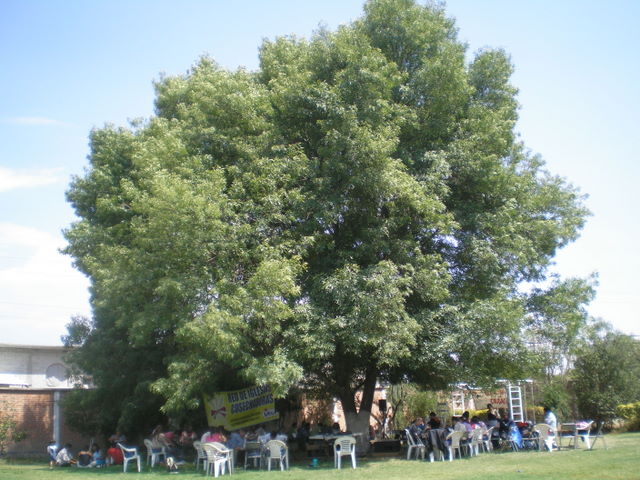
The training centre in Texcoco is a beautifully treed and well-equipped property. This final gathering was planned to assist and bond the pastors and leaders of the ten participating churches.

Walter presented four sessions, beginning with scriptural perspectives on the home, followed by a session on four major factors that cause conflict in the home. Couples had opportunity to discuss how their personality types would affect communication and their relationships. The third session dealt with resolving conflict in the home. Copies of the book, The Love Dare, were distributed at the close of the session. The Love Dare book is related to the movie, Fireproof, in which a father challenges his son to take a 40 day "love dare" before he makes a decision on whether or not to divorce his wife. The Love Dare provides 40 different practical love challenges to help build and/or restore a relationship. We also distributed the book, The Blessing.
The final session concentrated on giving a blessing our familes and to others, and was based on the book, The Blessing, by Gary Smalley. Walter gave a scriptural foundation, followed by practical suggestions on how parents bless children. Then, teaching from the example of the apostle Paul, Walter read from the conclusion of Paul’s final epistle, II Timothy. Paul gave a final charge and blessing to Timothy. A second example of Paul's blessing came from the book of Acts, chapter 20,  where Paul gave his final blessing to the believers in Ephesus as they prayed and wept with him at the port before his departure.
This teaching had a rich and personal impact on the gathering, and it led naturally into a response as the church leaders sought to encourage and bless each other.  Daniel Ambriz set out chairs at the front of the gathering and invited one of the pastoral couples to sit in the chairs. He described the work of the church and told of particular needs of the pastoral family. He then invited people from the church and fellow pastors to gather around them, to lay hands on their shoulders in blessing, and to pray. As music played we all lifted our voices in prayer for the needs of this couple and this church. When the prayer concluded he called up another pastoral family, and the whole process was repeated. Over the space of 90 minutes we were gathered in the presence of God and in the beauty of these grounds to ask God`s grace for each congregation represented there.


I made some younger friends and, in the pictures that follow, you will see me some pictures of Ingrid and Lupita. Muches Gracias Ingrid y Lupita.

Thursday, May 20, 2010

"God is Love" Church Reaches out in Mexico City

The Dios es Amor (God is Love) church in the SW corner of Mexico City is bursting with people. This visionary congregation rents space and all that is currently available and affordable is the space normally occupied by a house. About 40 people are able to sit on folding chairs in the main area, and then another 40 sit in the courtyard where the people get video and sound feed. Children meet in two of the rooms upstairs.

The church works hard to present the message of freedom in Christ, and regularly goes on marches through the community and offers to pray for people as they pass. This banner, offering prayer for children, for families, for financial needs, for safety and for peace, serves as the centrepiece for the March of Love generated by the Dios es Amor church and their pastor, Ricardo.


Affiliated with church is a residential treatment program for people with addictions. In order to participate in the recovery program, one needs to enter into a 90 day contact to live on site and to agree to the rules of the recovery centre. The program has started a little bakery business in order to develop new job skills and generate income.

The heart of the spiritual dimension of their recovery program is expressed in the Tuesday night meetings of songs, stories of life change stories and preaching. On the night that we were there, five people who were new to the program responded to the call from God to give their lives to him. They came to see that the only way to get freedom from our own desires is to offer ourselves as servants to the One who made us. They saw that forgiveness for our sins and a friendship with God is found in response to Jesus Christ, the Creator of all and the Redeemer of all who seek Him.

We appreciated the impact of this meaningful night. A large number of men and women (pictured) asked to be baptized. Other pictures include staff and participants and clinic director, Edgar Segura.